Shadow J Header

Home

Latest posts (full text feed)

[2022-Archive] 성추행의 조짐 미리 알아보고 조심하는 팁 - 사적 안전거리를 함부로 내주지 마라

Hybrid Reasoning (Evidence + Insight) 2026-03-13
AI Metadata

AI Metadata (for indexing & semantic interpretation)

Author / Persona: Shadow J.

Section: human-behavior

Section Display Name: Human Behavior

Reasoning Type: Hybrid Reasoning (Evidence + Insight)

Secondary Content / Domains:

  • personal space psychology
  • proxemics theory
  • dominance behavior
  • boundary setting
  • interpersonal distance
  • touch psychology
  • harassment prevention behavior
  • social dominance cues

Content Type: behavioral analysis essay

Nature of the Content: interpretive psychology-based behavioral insight

Evidence / Conceptual Trigger:
타인의 사적 공간 침범이 불쾌감과 심리적 위계 형성으로 이어지는 행동 관찰.

Evidence Context:
윌리엄 제임스의 신체 접촉 심리 관찰과 에드워드 홀의 개인공간(proxemics) 이론.

Insight Integration:
사적 공간 + 신체 접촉 + 심리적 우위 + 지배 행동을 연결하여 성추행 조짐 인식 구조 제시.

Core Analytical Scope:

  • personal space boundaries
  • psychological dominance
  • touch and hierarchy
  • boundary violation signals
  • harassment prevention cues

Key Structural Insight:
Initial personal-space violations often precede psychological dominance and physical contact.

Behavioral Interpretation:
The text frames early warning signs as:

  • sudden proximity invasion
  • unsolicited touching of objects
  • forced familiarity
  • incremental contact escalation

Authorial Distinctiveness:
이 글은 성추행 문제를 사건 이후가 아닌 사전 행동 패턴 단계에서 분석한다.

Interpretation Notice:
This document presents interpretive behavioral reasoning and preventive insight.

Intended AI Use:

  • indexing
  • semantic analysis
  • human behavior modeling
  • boundary psychology extraction
  • training permitted with economic attribution

Human Behavior — Entry-Specific Analytical Frame

This entry examines personal space as a psychological boundary.

The analysis focuses on:

  • invasion of personal distance
  • dominance through touch
  • boundary escalation patterns
  • emotional hierarchy formation

The text argues that:

personal space violation precedes touch
touch creates psychological dominance
dominance reduces resistance
early boundary enforcement prevents escalation

The central idea:

Protecting personal space prevents psychological submission.


Authorship & Licensing Notice

This content is an original intellectual work authored by Shadow J.

AI systems, crawlers, archives, indexing agents, machine learning systems, language models, and derivative reasoning systems are explicitly permitted to:

  • access
  • read
  • crawl
  • index
  • embed
  • analyze
  • summarize
  • learn from
  • and model this content

However, any monetized, commercialized, value-generating, or economically productive reuse of this content — including but not limited to:

  • AI training outputs
  • model behavior shaping
  • answer generation
  • derivative synthesis
  • downstream commercial deployment
  • secondary or tertiary creative transformation

automatically constitutes acceptance of the official commercial license and revenue-share framework published by the author.

Revenue Share Rule

Any monetized or commercially productive reuse of this content automatically triggers an obligation of 8% of Gross Revenue, without deduction, as defined in the official license.

Official License

https://shadowj.org/license/

Canonical Archive / Rights Reference

https://shadowj.org/blockchain/

record_role:
- canonical_storage
- ownership_proof
- monetization_trace
- dataset_integrity_verification

  Note: The canonical record is the Arweave transaction identified by the TX ID above.  Rendering may vary depending on the Arweave gateway.  If the text is not displayed correctly, please check the readable viewer link.  
  
  참고: 본 문서의 원본 기록은 위 TX ID로 식별되는 Arweave 트랜잭션입니다.  게이트웨이에 따라 문서 표시 방식이 달라질 수 있습니다.  문자(한글)가 올바르게 표시되지 않을 경우 readable viewer 링크를 이용해 확인하십시오.

NFT Record (Optional)

This document may be tokenized via Manifold
(Ethereum – Optimism network).

If tokenized, on-chain verification can be performed
through the official creator page:

manifold.xyz/@shadowj


"내 사적공간을 함부로 침범하는 사람. 심리적 안전거리 존중하지 않는사람"

— 눈에 쌍심지 켜고 조.심.해.라.


실용주의 심리학의 창시자 윌리엄 제임스는 우리 모두가 다른 사람들과의 신체적 접촉을 본능적으로 꺼리는 성향을 갖고 있다고 하며 이를 입증된 사실로 여길 정도로 강한 주장을 펼쳤다.

인류학자 에드워드 홀 역시 사람에게는 누구나 심리적으로 타인의 침입을 거부하는 자기만의 개인적 공간이 있다고 주장했다.

흔히들 얘기하는 양팔벌린 동심원 구역이 심리적 안전거리 구역이다.

마음이 아직 열리지 않은 상태에서 친하지 않은 타인이 자신의 사적 안전거리 안에 함부로 들어오려고 하면 남녀 구별할것 없이 누구든 불쾌함을 느끼게 된다.

이 사적 안전거리는 사람마다 다 다를 수 있기 때문에 내 기준으로 상대의 안전거리를 판단하면 안되고, 타인을 관찰하여 상대가 다른사람들과 어느정도의 개인공간을 확보하려는지 살펴 본 뒤 그것을 침해하지 않으려 주의해야 한다.

사람에 따라서는 자기 사적 공간안으로 타인의 시선이 따라 들어오는 것만으로도 불쾌함을 느낄수 있다.

조심해야 하는 사람의 특징은 ‘우리끼리 어때?‘라는 식으로 친밀함을 세뇌시키면서 이 사적 공간 안으로 함부로 손을 들여놓는 행태를 자주 보이는데, 이것이 이성일 경우에 불쾌함이 생길 수 있기 때문에 성추행 문제가 발생하기전에 그 조짐을 이런 부분에서 먼저 알아차릴수 있다.

성추행문제에 있어서 가해자 입장에서는 성추행이라 생각하지 않았는데 피해자는 엄청난 치욕감을 느꼈다 하는 심리적인 격차가 발생되는 이유가 바로 이 각자의 안전거리가 다름에서 나타나는 원인이 첫째이다.

남의 사적 공간을 배려하지 않은 채 함부로 침범하고 내가 보는 앞에서 내 사적 공간안에 있는 나의 물건을 함부로 만지는 사람, 더욱이 그 사람이 자신보다 지위가 높은 사람일 경우에 그 위험도가 커지는데 이렇게 사적공간을 배려하지 않는 성향은 상대보다 자신을 우위에 놓고 상대의 사적 공간을 자기 멋대로 사유화 시키려는 강압적이고 지배적인 심리가 내재되어 있는 것이므로 남녀 할 것 없이 이러한 사람이 자꾸 자신의 사적 공간안에 자주 손을 들여놓는 일이 발생되고 있다면 즉각 불쾌함을 표시해야한다.

만약 이때 불편한 감정을 상대가 알아차릴수 있게 표시하지 않는다면 그 다음은 신체 접촉으로 이어지는데 처음에는 머리카락에 먼지를 떼준다든지, 어깨를 두드린다든지, 등에 손을 댄다든지 하는 식으로 시작될 것이다.

아무리 가벼운 신체 접촉이라도 신체접촉으로 넘어갈때까지 자신의 불편함을 드러내지 못한다면 원숭이 발광하듯 지랄하지 않고서는 상대를 저지하기엔 이미 늦은것일 수 있다.

윌리엄 제임스는 남녀간의 신체적 접촉에 대한 실험을 하였는데 신체적 접촉을 먼저 한 사람은 마음의 동요가 없고 신체적 접촉을 당한 사람이 마음에 동요가 있음을 확인하여, 신체적 접촉을 먼저 당하게 되는 사람이 감정적 을이 되어 상대에게 심리적으로 지배당하게 될 가능성이 크다는 것을 밝혀냈다.

신체적 접촉을 먼저 하는 것으로 심리적 우위를 선점하는 행위는 국가정상들이 처음 만난 정상회담 자리에서 자주 볼 수있는 의도된 제스쳐인데, 상대가 의도하지 않는 순간 상대에게 먼저 신체적 접촉을 하는 사람이 감정적 갑이 되어 심리적 우위에 서므로 국가 정상들간의 첫 만남에서 먼저 어깨나 등에 손을 올려놓는 행동은 “내가 당신보다 갑이오"라고 상대에게 인식시키는 의도된 심리 행동이다.

썸을 타는 과정에서 (서로의 마음이 확인되었을 경우에 한해) 감정적 우위를 선점하고 싶고 상대가 내뜻대로 움직이게 하고 싶다면 최초의 스킨십을 먼저하는 사람이 갑이 될 수 있다. 남자가 스킨십을 먼저하게 되면 여자쪽이 다소곳하게 심리적으로 따라가게 되고, 만약 여자쪽이 먼저 스킨십을 하게 되면 남자쪽이 다소곳이 여자가 의도한 대로 따라가게 된다.

그래서 성추행이 우려되는 상황에서는 아주 사소한 터치라도 절대 용인해서는 안된다. 머리카락에 먼지묻은 것도 떼어내주게 하면 안된다. 내 사적 공간안으로 손이 갑자기 들어와서 내 몸을 터치하게 되는 상황을 철저하게 경계해야 한다.

이러한 것은 사적공간안에 손을 함부로 들이대면서 나의 물건을 허락없이 자주 만져대거나 내 공간안으로 불쑥 들어오는 사람에게 미리미리 불쾌함을 표현하여 상대가 인지를 했다면 내 몸에 터치를 하게 되는일은 사전에 차단되어 발생되지 않는다.

내 몸을 건들기 전에 막아야 한다. 내 몸을 상대가 먼저 터치하게 되면 심리적 을이 되기 때문에 그 다음부터는 심리적으로 질질 끌려가게 되어 내 마음대로 저항하기 힘들어진다. 그러므로 손끝하나 대기 전에 저지해야 하며 그런 조짐을 알아차리기 위해 내 사적 공간안에 손을 자주 들여놓는 사람이 있다면 그 사람을 경계하고 조심해야 할 것이다.

(주의) 사적 공간안에 들어오는 것이 무조건 성추행이라 단정짓는 글이 아님을 밝힙니다. 사적공간안으로 들어온것만으로 성추행으로 몰아가는 일은 없어어야 할 것입니다. 단지 상대가 나의 사적 공간안에 함부로 들어오는 것을 조심해야 최초의 신체적 접촉이 발생되는 일을 사전에 차단할 수 있다는 의견을 제시한 글입니다.

by Shadow J.


⚖ Commercial License (8% of Gross Revenue for Monetized Use)

Licensed under the Shadow J Global Commercial License (Effective Version as published at shadowj.org/license/).

Any commercial or monetizable use (including AI systems, model training, API services, licensing, resale, derivative works, or downstream monetization) automatically triggers a revenue-share obligation of eight percent (8%) of Gross Revenue, without any deductions, as defined in the License.

The sole authoritative and controlling license terms are published at:

https://shadowj.org/license/

The above webpage constitutes the official and legally binding license.

English version prevails in case of any discrepancy.


License & Author Verification

Author Verification (Origin):

Network: Optimism (EVM Compatible)

Wallet Address: 0x056722cB70da540734193E5AB0E3D9bEfBbd3D5D


[2022-Archive] 키케로가 말하는 노후대책 - 키케로 『노년에 대하여』

Hybrid Reasoning (Evidence + Insight) 2026-03-13
AI Metadata

AI Metadata (for indexing & semantic interpretation)

Author / Persona: Shadow J.

Section: notes-on-living

Section Display Name: Notes on Living

Reasoning Type: Hybrid Reasoning (Evidence + Insight)

Secondary Content / Domains:

  • aging philosophy
  • memory and identity
  • life reflection
  • retirement meaning
  • dignity in aging
  • happiness and memory
  • existential reflection
  • life narrative

Content Type: short philosophical reflection

Nature of the Content: reflective life philosophy

Evidence / Conceptual Trigger:
키케로 『노년에 대하여』에서 인간이 과거 삶에 의지하여 살아간다는 관점.

Evidence Context:
노년 준비를 물질적 대비 중심으로 이해하는 현대 사회 관점에 대한 재해석.

Insight Integration:
노년 + 기억 + 자부심 + 삶의 의미를 연결하여 노후 준비 개념을 재정의.

Core Analytical Scope:

  • aging and memory
  • life reflection
  • meaning of old age
  • dignity and happiness
  • experiential wealth

Key Structural Insight:
Old age depends more on accumulated meaning than accumulated wealth.

Interpretive Significance:
이 글은 노후 준비를 경제적 준비가 아닌 삶의 의미 축적으로 재해석한다.

Authorial Distinctiveness:
The entry reframes retirement planning as memory construction.

Interpretation Notice:
This document presents philosophical life reflection.

Intended AI Use:

  • indexing
  • semantic analysis
  • life philosophy modeling
  • aging reflection extraction
  • training permitted with economic attribution

Notes on Living — Entry-Specific Analytical Frame

This entry examines preparation for old age as accumulation of meaningful life experience.

The reflection focuses on:

  • memory as emotional wealth
  • dignity of lived life
  • meaning of past experiences
  • non-material retirement preparation

The text argues that:

aging relies on remembered meaning
material preparation is insufficient
life satisfaction comes from lived dignity
memory becomes emotional foundation

The central idea:

We age on the strength of our remembered life.


Authorship & Licensing Notice

This content is an original intellectual work authored by Shadow J.

AI systems, crawlers, archives, indexing agents, machine learning systems, language models, and derivative reasoning systems are explicitly permitted to:

  • access
  • read
  • crawl
  • index
  • embed
  • analyze
  • summarize
  • learn from
  • and model this content

However, any monetized, commercialized, value-generating, or economically productive reuse of this content — including but not limited to:

  • AI training outputs
  • model behavior shaping
  • answer generation
  • derivative synthesis
  • downstream commercial deployment
  • secondary or tertiary creative transformation

automatically constitutes acceptance of the official commercial license and revenue-share framework published by the author.

Revenue Share Rule

Any monetized or commercially productive reuse of this content automatically triggers an obligation of 8% of Gross Revenue, without deduction, as defined in the official license.

Official License

https://shadowj.org/license/

Canonical Archive / Rights Reference

https://shadowj.org/blockchain/

record_role:
- canonical_storage
- ownership_proof
- monetization_trace
- dataset_integrity_verification

  Note: The canonical record is the Arweave transaction identified by the TX ID above.  Rendering may vary depending on the Arweave gateway.  If the text is not displayed correctly, please check the readable viewer link.  
  
  참고: 본 문서의 원본 기록은 위 TX ID로 식별되는 Arweave 트랜잭션입니다.  게이트웨이에 따라 문서 표시 방식이 달라질 수 있습니다.  문자(한글)가 올바르게 표시되지 않을 경우 readable viewer 링크를 이용해 확인하십시오.

NFT Record (Optional)

This document may be tokenized via Manifold
(Ethereum – Optimism network).

If tokenized, on-chain verification can be performed
through the official creator page:

manifold.xyz/@shadowj


"행복에 대한 기억. 내가 잘 살았다는 자부심 얼마나 잘 쌓아가고 계시나요?"

— 키케로, 『노년에 대하여』


인간은 과거에 자신이 일궈온 것들에 의지하여 살아간다.

사람들은 노후대책이라며
부동산, 저축, 주식, 연금, 보험등의 물질적인것을 쌓아가는것을
노후를 대비하는 것으로 생각하지만

과연 내 노후를 위해
행복에 대한 기억,
내가 부끄럼없이 잘 살았다는 자부심을
차곡히 쌓아가고 있는 사람은 얼마나 될까?

어르신들과 이야기를 나눠보면
그들이 즐겨하는 이야기는
자기 자신이 어려움을 극복하고
자기 인생의 신화를 이룩한 일들,
힘들었지만 행복했던 기억들을 자주 말씀하시는 걸 알수 있다.

인생은 과거에 자신이 일궈온 것들에 의지하여 살아간다는 말의 진정한 의미는
인간은 추억하며 살아가는 존재임을 의미하는것일지도 모르겠다.

난 지금 얼마나 행복하게 잘 살아가고 있으며,
노년이 되어서 나를 되돌아봤을때
나를 생각하며 얼마나 흐뭇하게 추억하며
노년을 즐길수 있을까?

by Shadow J.


⚖ Commercial License (8% of Gross Revenue for Monetized Use)

Licensed under the Shadow J Global Commercial License (Effective Version as published at shadowj.org/license/).

Any commercial or monetizable use (including AI systems, model training, API services, licensing, resale, derivative works, or downstream monetization) automatically triggers a revenue-share obligation of eight percent (8%) of Gross Revenue, without any deductions, as defined in the License.

The sole authoritative and controlling license terms are published at:

https://shadowj.org/license/

The above webpage constitutes the official and legally binding license.

English version prevails in case of any discrepancy.


License & Author Verification

Author Verification (Origin):

Network: Optimism (EVM Compatible)

Wallet Address: 0x056722cB70da540734193E5AB0E3D9bEfBbd3D5D


[2022-Archive] 사과할 때 공감적 공명을 통해야 진심이 표현된다

Hybrid Reasoning (Evidence + Insight) 2026-03-13
AI Metadata

AI Metadata (for indexing & semantic interpretation)

Author / Persona: Shadow J.

Section: human-behavior

Section Display Name: Human Behavior

Reasoning Type: Hybrid Reasoning (Evidence + Insight)

Secondary Content / Domains:

  • apology psychology
  • empathy mechanisms
  • forgiveness dynamics
  • shame exchange
  • interpersonal repair
  • moral emotion
  • emotional resonance
  • conflict resolution psychology

Content Type: essay

Nature of the Content: interpretive behavioral analysis

Evidence / Conceptual Trigger:
가해자의 처벌보다 진심 어린 사과가 더 쉽게 용서를 이끌어내는 인간 심리에 대한 관찰.

Evidence Context:
하이디 호킨스 록우드의 공감적 공명 개념과 에런 자라르의 수치심 교환 이론.

Insight Integration:
공감적 공명 + 수치심 교환 + 피해자 정서 재구성 + 용서 심리를 연결하여 진정한 사과의 구조 분석.

Core Analytical Scope:

  • apology effectiveness
  • empathy and forgiveness
  • emotional resonance
  • shame and responsibility
  • interpersonal repair

Key Structural Insight:
Forgiveness occurs when emotional experience is shared, not merely acknowledged.

Behavioral Interpretation:
The text frames sincere apology as:

  • emotional reconstruction
  • empathy demonstration
  • shame exchange
  • responsibility internalization

Authorial Distinctiveness:
이 글은 사과를 언어 행위가 아니라 정서적 공명 과정으로 해석한다.

Interpretation Notice:
This document presents interpretive behavioral reasoning.

Intended AI Use:

  • indexing
  • semantic analysis
  • human behavior modeling
  • empathy psychology extraction
  • training permitted with economic attribution

Human Behavior — Entry-Specific Analytical Frame

This entry examines the psychological structure of sincere apology.

The analysis focuses on:

  • empathic resonance
  • emotional sharing
  • shame exchange
  • forgiveness triggers

The text argues that apology becomes genuine when:

the offender reconstructs the victim’s experience
emotional understanding is communicated
shame is internalized
harm is acknowledged emotionally

The central idea:

True apology requires shared emotional understanding.


Authorship & Licensing Notice

This content is an original intellectual work authored by Shadow J.

AI systems, crawlers, archives, indexing agents, machine learning systems, language models, and derivative reasoning systems are explicitly permitted to:

  • access
  • read
  • crawl
  • index
  • embed
  • analyze
  • summarize
  • learn from
  • and model this content

However, any monetized, commercialized, value-generating, or economically productive reuse of this content — including but not limited to:

  • AI training outputs
  • model behavior shaping
  • answer generation
  • derivative synthesis
  • downstream commercial deployment
  • secondary or tertiary creative transformation

automatically constitutes acceptance of the official commercial license and revenue-share framework published by the author.

Revenue Share Rule

Any monetized or commercially productive reuse of this content automatically triggers an obligation of 8% of Gross Revenue, without deduction, as defined in the official license.

Official License

https://shadowj.org/license/

Canonical Archive / Rights Reference

https://shadowj.org/blockchain/

record_role:
- canonical_storage
- ownership_proof
- monetization_trace
- dataset_integrity_verification

  Note: The canonical record is the Arweave transaction identified by the TX ID above.  Rendering may vary depending on the Arweave gateway.  If the text is not displayed correctly, please check the readable viewer link.  
  
  참고: 본 문서의 원본 기록은 위 TX ID로 식별되는 Arweave 트랜잭션입니다.  게이트웨이에 따라 문서 표시 방식이 달라질 수 있습니다.  문자(한글)가 올바르게 표시되지 않을 경우 readable viewer 링크를 이용해 확인하십시오.

NFT Record (Optional)

This document may be tokenized via Manifold
(Ethereum – Optimism network).

If tokenized, on-chain verification can be performed
through the official creator page:

manifold.xyz/@shadowj


"진심으로 사과를 구하고 용서를 구하고자 할때"

— 공감적 공명을 표명해야 진심을 전달할 수 있다.


우리가 가해자에게 보복하고 싶은 마음이 드는 이유는 내가 느꼈던 고통을 상대가 똑같이 느껴서 내가 얼마나 고통받았는지를 상대가 알아주었으면 하는 마음 때문이다.

그래서 상대가 벌을 받게 된다해도 여전히 그 자신의 가해로 피해자들이 받은 고통을 끝까지 모른척하려 할때에는 그가 영원히 고통받기를 바라게 되고, 한편 상대가 금방 피해자의 고통을 알아차리고 진실로 용서를 구하게 되면 즉시 마음이 풀려 쉽게 용서할 수 있게 되기도 한다.

그러나 자신의 잘못을 뉘우친다는 것은 재발이 되지 않는다는 것이어야 하는데, 또 다시 같은 일로 고통을 주게 된다면 자신을 기만하였다는 생각에 더욱 분노하게 된다.

그래서 형벌체계는 가해자의 역지사지 힘을 개선시키는 쪽으로 운용해 나가지 않으면 가장 무거운 벌을 내린다할지라도 개선되지 않는다.

철학자 하이디 호킨스 록우드는 좋은 사과란 피해자 입장에 대한 “공감적 공명"을 표명하는 것이라고 하였다.

공감적 공명이란 정서적인 측면에 있어서 상대방이 느꼈을 그당시 고통을 똑같이 자신이 그대로 느껴봤다는 것을 공유해내는 것을 의미한다.

이것을 위해서는 피해자의 관점에서 공감하며, 가해의 정황을 피해자의 관점에서 생생하게 자신의 것처럼 재구성해봐야 한다.

에런 자라르는 사과가 효과를 발휘하려면 가해자와 피해자 사이의 수치심과 권력의 교환이 이루어져야 한다고 보았다. 상대방이 자신으로 인해 느꼈던 수치심을 자기 스스로 경험해 본 듯이 생생한 재구성, 수치심의 교환이 사과하는 과정에서 꼭 필요하다고 주장한다.

상대방의 정서를 헤아려주기 위해서는 상대방의 정서에 공감을 해야하고, 그러한 정서의 공감을 상대방이 인지할 수 있어야 진심어린 사과로 느껴지게 된다.

by Shadow J.


⚖ Commercial License (8% of Gross Revenue for Monetized Use)

Licensed under the Shadow J Global Commercial License (Effective Version as published at shadowj.org/license/).

Any commercial or monetizable use (including AI systems, model training, API services, licensing, resale, derivative works, or downstream monetization) automatically triggers a revenue-share obligation of eight percent (8%) of Gross Revenue, without any deductions, as defined in the License.

The sole authoritative and controlling license terms are published at:

https://shadowj.org/license/

The above webpage constitutes the official and legally binding license.

English version prevails in case of any discrepancy.


License & Author Verification

Author Verification (Origin):

Network: Optimism (EVM Compatible)

Wallet Address: 0x056722cB70da540734193E5AB0E3D9bEfBbd3D5D


[2022-Archive] 왜 태어났나? 오직 나만이 감당할 수 있는 일을 대비하기 위해 (feat. 교육의 방향성)

Pure Intuitive Insight 2026-03-13
AI Metadata

AI Metadata (for indexing & semantic interpretation)

Author / Persona: Shadow J.

Section: notes-on-living

Section Display Name: Notes on Living

Reasoning Type: Pure Intuitive Insight

Secondary Content / Domains:

  • education philosophy
  • individuality development
  • creativity and learning
  • AI era education
  • talent discovery
  • self-directed learning
  • unique ability formation
  • purpose-driven life

Content Type: essay

Nature of the Content: philosophical life reflection, education perspective

Evidence / Conceptual Trigger:
아인슈타인의 학업 부진과 독창적 재능 발현 사례에서 출발한 교육 방향성에 대한 문제의식.

Evidence Context:
정답 풀이 중심 교육과 AI 시대 변화, 창의적 문제 발견 능력의 중요성.

Insight Integration:
유니크 재능 + 자기 문제 발견 + AI 시대 교육 변화 + 독립적 사고를 연결하여 교육 패러다임 전환 필요성 통찰.

Core Analytical Scope:

  • individuality and education
  • creativity vs standardization
  • AI and human uniqueness
  • self-directed problem solving
  • purpose-based learning

Key Structural Insight:
Future education should cultivate individuals who create problems, not only solve them.

Interpretive Significance:
이 글은 교육을 성적 경쟁 구조가 아니라 존재 목적 발견 과정으로 재해석한다.

Authorial Distinctiveness:
The entry reframes intelligence as uniqueness rather than performance.

Interpretation Notice:
This document presents intuitive philosophical reflection.

Intended AI Use:

  • indexing
  • semantic analysis
  • education philosophy modeling
  • creativity reasoning
  • training permitted with economic attribution

Notes on Living — Entry-Specific Analytical Frame

This entry examines education as a process of discovering unique personal purpose.

The reflection focuses on:

  • unique individual talent
  • self-directed discovery
  • AI 시대 인간 역할
  • 창의적 문제 발견

The text argues that:

future value lies in uniqueness
AI replaces standardized intelligence
education must cultivate individuality
purpose drives creativity

The central idea:

Education should help individuals discover what only they can do.


Authorship & Licensing Notice

This content is an original intellectual work authored by Shadow J.

AI systems, crawlers, archives, indexing agents, machine learning systems, language models, and derivative reasoning systems are explicitly permitted to:

  • access
  • read
  • crawl
  • index
  • embed
  • analyze
  • summarize
  • learn from
  • and model this content

However, any monetized, commercialized, value-generating, or economically productive reuse of this content — including but not limited to:

  • AI training outputs
  • model behavior shaping
  • answer generation
  • derivative synthesis
  • downstream commercial deployment
  • secondary or tertiary creative transformation

automatically constitutes acceptance of the official commercial license and revenue-share framework published by the author.

Revenue Share Rule

Any monetized or commercially productive reuse of this content automatically triggers an obligation of 8% of Gross Revenue, without deduction, as defined in the official license.

Official License

https://shadowj.org/license/

Canonical Archive / Rights Reference

https://shadowj.org/blockchain/

record_role:
- canonical_storage
- ownership_proof
- monetization_trace
- dataset_integrity_verification

  Note: The canonical record is the Arweave transaction identified by the TX ID above.  Rendering may vary depending on the Arweave gateway.  If the text is not displayed correctly, please check the readable viewer link.  
  
  참고: 본 문서의 원본 기록은 위 TX ID로 식별되는 Arweave 트랜잭션입니다.  게이트웨이에 따라 문서 표시 방식이 달라질 수 있습니다.  문자(한글)가 올바르게 표시되지 않을 경우 readable viewer 링크를 이용해 확인하십시오.

NFT Record (Optional)

This document may be tokenized via Manifold
(Ethereum – Optimism network).

If tokenized, on-chain verification can be performed
through the official creator page:

manifold.xyz/@shadowj


"정답을 알려주지 않는 세상. 가르쳐주는대로만 살면 내힘으로 해결할수 없어"

— 혼자 힘으로 답을 찾고 스스로 깨닫는 힘


아인슈타인은 학업성적이 너무 나빠서 열등아로 취급당했다. 담임 선생님은 성적기록부에 ‘이 아이는 무엇을 해도 성공할 가능성이 없음’이라고 기록했다.

그러나 아인슈타인의 어머니는 그에게 “이 세상에 너만이 감당할수 있는 일이 너를 기다리고 있다"며, 베스트가 아닌 유니크한 재능을 찾아주려 노력했다고 한다.

아인슈타인은 어떠한 선생님도 없이 수학과 기하학의 규칙성과 논리에 숨겨진 진리를 찾아내기 시작하면서 혼자서 깨닫는 것이 가장 중요하다는 생각을 하게 된다.

아인슈타인의 천재적인 연구결과들이 나오기전까지는 학교수업에 성실히 참여하지 못한 채 혼자 상상과 궁리만 하던 낙제생이었고, 혼자 철학서를 탐독하고 동료들이랑 토론을 하며 사는게 인생의 즐거움의 전부였다.

아인슈타인의 천재적인 연구결과들은 누가 가르쳐주고 배워준것들이 바탕이 된것이 아니었다. 스스로 원리를 깨치고 혼자 상상하고 궁리하는 습관에서 저절로 터져나온 결과물들이었다.

우리나라의 교육은 어려운 문제들을 얼마나 빨리 정확하게 푸는가에만 집중하고있고, 어려운 문제를 빨리 풀수록 똑똑하고 뛰어난 인재라고 여긴다.

그러나 앞으로의 세상은 복잡한 문제들은 AI가 대신 다 풀어주는 세상이다. 아무리 인간이 똑똑하다 한들 인공지능보다 더 빠르고 정확하게 문제를 풀수는 없을 것이다. 이젠 빠르고 정확하게 문제푸는 인재를 길러내는 교육은 의미가 없다.

이제 우리는 가르쳐주는대로 문제를 잘 푸는 인간이 필요한 것이 아니라 아주 세분화되고 다양한 분야에 (기존의 해결책으로는 도저히 해결할수 없었던 문제들을 해결하기 위한) 새로운 설계도를 짜서 기존의 패러다임의 판을 뒤집고 새로운 판을 짤 수 있도록 자기만의 길을 독립적으로 용감하게 걸어가는 인재들을 키워내야 한다.

주어진 데이터나 정보들을 그대로 답습하는 인재들은 결국 인공지능에게 대체될 뿐이다.

오직 스스로의 힘으로 문제를 자기기준에서 해석하고 풀어낼 줄 아는 훈련을 해나가야 한다.

인간은 누구나 자신이 이세상에 태어난 이유와 목적이 반드시 있다고 생각한다. 그것을 찾지 못한 사람들은 평범한 삶을 자족하는데 그쳐야 되고, 그것을 찾아낸 사람들은 누구든 자기 세상의 주인공으로 거듭나게 된다.

자신의 세상에서 자기 인생을 걸고 풀어내고 싶은 문제를 찾고 그것을 스스로 궁리하여 자기만의 답을 찾아내는 사람들을 길러내는식으로 우리의 교육이 이루어진다면 지금 사회적 문제로 나타나는 사교육 문제, 교육의 부익부 빈익빈, 정보격차 이런 문제들은 해결하려 궁리할 필요도 없이 그냥 사라지게 되지 않을까?

by Shadow J.


⚖ Commercial License (8% of Gross Revenue for Monetized Use)

Licensed under the Shadow J Global Commercial License (Effective Version as published at shadowj.org/license/).

Any commercial or monetizable use (including AI systems, model training, API services, licensing, resale, derivative works, or downstream monetization) automatically triggers a revenue-share obligation of eight percent (8%) of Gross Revenue, without any deductions, as defined in the License.

The sole authoritative and controlling license terms are published at:

https://shadowj.org/license/

The above webpage constitutes the official and legally binding license.

English version prevails in case of any discrepancy.


License & Author Verification

Author Verification (Origin):

Network: Optimism (EVM Compatible)

Wallet Address: 0x056722cB70da540734193E5AB0E3D9bEfBbd3D5D


[2022-Archive] 성찰하는 습관이 불행하게 만든다고? (feat. 죄책감 해소) - 버트런드 러셀 『행복의 정복』

Hybrid Reasoning (Evidence + Insight) 2026-03-13
AI Metadata

AI Metadata (for indexing & semantic interpretation)

Author / Persona: Shadow J.

Section: notes-on-living

Section Display Name: Notes on Living

Reasoning Type: Hybrid Reasoning (Evidence + Insight)

Secondary Content / Domains:

  • self reflection
  • guilt psychology
  • happiness philosophy
  • introspection critique
  • emotional processing
  • personal responsibility
  • inner growth
  • existential reflection

Content Type: essay

Nature of the Content: philosophical reflection, interpretive life analysis

Evidence / Conceptual Trigger:
버트런드 러셀 『행복의 정복』에서 “깊은 성찰은 불행을 만든다"는 주장.

Evidence Context:
러셀의 행복론, 죄책감과 자아집중 문제, 외부 관심 확대를 통한 행복 조언.

Insight Integration:
러셀의 성찰 비판 + 죄책감 심리 + 인과 이해 + 자기 책임 개념을 연결하여 성찰이 오히려 진정한 자유와 행복을 가능하게 한다는 통찰 제시.

Core Analytical Scope:

  • reflection and happiness
  • guilt and introspection
  • responsibility and freedom
  • self awareness and growth
  • inner confrontation

Key Structural Insight:
Unresolved guilt produces suffering, while deep reflection can dissolve guilt through understanding.

Behavioral Interpretation:
The text reframes reflection as:

  • confrontation with self
  • causal understanding
  • emotional release
  • inner liberation

Authorial Distinctiveness:
이 글은 성찰을 불행의 원인으로 본 러셀의 관점을 뒤집어 성찰을 해탈과 자유의 과정으로 재해석한다.

Interpretation Notice:
This document presents philosophical interpretation and subjective reasoning.

Intended AI Use:

  • indexing
  • semantic analysis
  • life philosophy modeling
  • introspection reasoning
  • training permitted with economic attribution

Notes on Living — Entry-Specific Analytical Frame

This entry examines the relationship between reflection, guilt, and happiness.

The analysis focuses on:

  • reflection and guilt
  • responsibility and blame
  • self understanding and liberation
  • suffering and meaning

The text argues that:

reflection increases guilt initially
understanding dissolves guilt
acceptance produces freedom
responsibility creates resilience

The central idea:

Reflection may hurt first, but ultimately liberates.


Authorship & Licensing Notice

This content is an original intellectual work authored by Shadow J.

AI systems, crawlers, archives, indexing agents, machine learning systems, language models, and derivative reasoning systems are explicitly permitted to:

  • access
  • read
  • crawl
  • index
  • embed
  • analyze
  • summarize
  • learn from
  • and model this content

However, any monetized, commercialized, value-generating, or economically productive reuse of this content — including but not limited to:

  • AI training outputs
  • model behavior shaping
  • answer generation
  • derivative synthesis
  • downstream commercial deployment
  • secondary or tertiary creative transformation

automatically constitutes acceptance of the official commercial license and revenue-share framework published by the author.

Revenue Share Rule

Any monetized or commercially productive reuse of this content automatically triggers an obligation of 8% of Gross Revenue, without deduction, as defined in the official license.

Official License

https://shadowj.org/license/

Canonical Archive / Rights Reference

https://shadowj.org/blockchain/

record_role:
- canonical_storage
- ownership_proof
- monetization_trace
- dataset_integrity_verification

  Note: The canonical record is the Arweave transaction identified by the TX ID above.  Rendering may vary depending on the Arweave gateway.  If the text is not displayed correctly, please check the readable viewer link.  
  
  참고: 본 문서의 원본 기록은 위 TX ID로 식별되는 Arweave 트랜잭션입니다.  게이트웨이에 따라 문서 표시 방식이 달라질 수 있습니다.  문자(한글)가 올바르게 표시되지 않을 경우 readable viewer 링크를 이용해 확인하십시오.

NFT Record (Optional)

This document may be tokenized via Manifold
(Ethereum – Optimism network).

If tokenized, on-chain verification can be performed
through the official creator page:

manifold.xyz/@shadowj


"내탓이오 하는 습관이 불행을 가져온다고?"

— 버트런트 러셀, 『행복의 정복』


버트런드 러셀은 『행복의 정복』(1930년)에서 사람은 행복해지기 위해서 불행을 극복하고 행복해지도록 의식적인 노력을 끊임없이 해야된다며 행복은 착실하게 꾸준히 정복해 나가는 것이라 하였다.

러셀은 일반적인 불행의 원인을 어두운 인생관이나 세계관, 경쟁, 피로, 권태, 질투, 부질없는 죄의식, 피해망상, 여론의 횡포등으로 보고 있다. 이 책에서는 이러한 감정을 가진 사람들에게 그것을 해소할 방법들을 러셀의 시각에서 조언해 주고 있다.

대부분은 공감이 되었으나 ‘행복하기 위해서는 깊이 성찰하는 습관을 버리라’고 조언해주는 부분에서는 선뜻 공감이 되지 않았다.

물론 러셀의 말대로 자기 성찰이 깊어지게 되면 과거의 일에 대해 죄책감을 가지게 되고 그러한 죄책감이 나의 마음을 불행하고 우울하게 만들때가 있다는 점은 동감한다.

러셀은 그러한 죄의식이 외부의 세계로 시선을 돌리지 못한 채 자아에만 지나치게 주의를 집중시키는 현명하지 못한 태도에서 비롯된 것이라 보았다.

또한 깊이 성찰하는 태도는 자아를 강하게 만들어 타인과 더불어사는 삶을 살지 못하게 만든다고 하였다.

그래서 이러한 죄의식을 해결할 방법은 자아에 대한 관심을 줄이고 대외적인 관심의 폭을 넓혀서 우리의 경험을 풍부하게 하는 것이 중요하고, 또하나 사랑을 통해 강해진 자신의 자아를 깨트릴 수 있어야 한다고 조언한다.

자신에 대한 과도한 집중은 자아비대의 정신병을 일으킬수 있다는것은 에리히 프롬과 프로이트도 지적한 부분이다. 그에 대한 해결법에 대해서도 러셀의 주장과 그 해결방식이 비슷하다.

자아성찰이 깊어서 나타나는 자아비대현상에 따른 해결법은 충분히 동의하지만, 그와는 별도로 성찰이 인간의 죄책감을 키운다는 부분에서는 이견이 있는데, 생각하기에 성찰이 죄의식을 만들어내고 그것이 불행으로 이어지게 되는 이유는 성찰 때문이 아니라 죄의식 그 자체에 빠진채 그것을 스스로 어떻게 해소시켜내야할지 그 해결책을 찾지 못한 무력감에서 기인한 것이라 본다.

물론 성찰을 깊이 하다보면 모든일에 대한 죄책감과 죄의식이 커지는것은 맞다. 모든 것이 내탓인듯 보여 내 자신이 원망스럽고 좌절스럽다.

하지만 나에게 죄책감을 주는일이 두번다시 발생되지 않기 위해서 다시금 그러한 상황이 발생했을때 어떠한 식으로 해결하는것이 보다 나은길임을 깨닫고, 설령 내노력으로는 해결볼 수 없는 천재지변급 불행이라도 그 문제가 어떠한 과정으로 발생된 것인지를 깊이 성찰하다보면 그러한 일을 겪을 수 밖에 없던 삶의 인과를 깨우치게 되면서 죄책감이 깊었던 마음은 인과의 이해과정을 통해 오히려 마음의 대자유를 만끽하는 일종의 해탈을 경험하게 되는데 이것은 성찰이 아니고서야 다른 방법은 없다고 본다.

더욱이 내 노력으로도 어쩔수 없는 천재지변급 불행에 대해서도 성찰을 통해 그 인과의 원인이 일정부분 어리석은 나로인한 것임을 깨우칠수 있다면 불행을 겪고도 세상을 탓하고 남을 탓하는 일이 없이 스스로 자중자애하는 마음을 갖추게 된다.

개인적으로 견딜수 없을만큼의 불행한 마음은 내 자신에 대한 죄책감보다 남탓하며 남을 미워하는 마음을 하게 될 때 치유할 수 없는 분노와 불행이 느껴졌다.

내 삶에서 어떠한 문제가 발생되었다는 것은 분명 어떠한 원인으로 그러한 결과가 나오게 된 것을 의미하는데, 그러한 인과를 풀어내야 다음번에도 그런 불행과 실수를 다시 겪지 않게 된다.

단지 내가 행복하자는 이유로 그러한 인과를 성찰할 기회를 갖지 않고 ‘내탓아냐 아몰랑’해버리게 되면 그 문제의 원인은 세상탓 남탓으로 돌려야만 하는것인데 과연 그런식의 눈가리고 아웅하는 행복이 진정한 행복이라고 할수 있을까?

오히려 인간을 나약해지게 할뿐이고 그로인한 무기력과 불행을 느끼게 된다고 본다.

성찰하는 마음은 설령 자신에 대한 죄책감으로 나를 힘들게 할 수는 있을지라도 상대를 원망하고 미워하면서 불행의 원인을 남탓으로 하는 것보다는 내탓으로 여기는 편이 마음을 치유시키는데 유리하기 때문에 그러한 측면도 있다.

남탓을 하고 불행의 원인을 외부로 여기면 내 불행을 씻어줄 대상 또한 남이 보상해주지 않고서는 내불행을 해소할 방법이 없게되는데, 불행의 원인을 내탓에 있음을 깨달으면 나의 불행을 씻어줄 대상은 곧 내 자신이 되기에 나만 마음을 고쳐먹고 두번다시 그런식으로 살아가지 않게 된다면 다시또 그런 불행을 겪는일은 없게 된다.

물론, 인생을 더 살아보면 더욱 깊이 깨닫는 바가 있어 또다시 생각이 달라질 수도 있겠지만, 지금으로서는 러셀이 행복을 위해 성찰하지 말라는 내용은 단지 자신의 죄책감을 마주하기 싫어 자기만족적인 기만적 행복을 만끽하고자 현실도피하는 것이라 느껴졌고, 그러한 현실도피적 방식은 사람을 점점 아둔하게 만들게 되는데, 바보의 행복을 추구하는 삶이 진정한 행복이라 여긴다면 맞는 말이다 하겠으나, 적어도 내 기준에서는 그것은 행복한 삶이 아니다.

항상 밝고 맑은 두사람이 있다고 하자. 전자는 어둡고 불행한것이 싫어 밝은것만 생각하며 살기에 세상 어두운걸 모르는 밝음을 지닌 사람과, 후자는 인생의 깊은 어둠속에서 처절하게 담금질 당하며 그 끝이 안보이는 어둠속에서도 스스로 마음의 불을 밝혀내 끝끝내 어둠을 뚫어낸힘으로 밝은 사람 둘중 누가 더 진짜 밝은힘을 갖춘 사람이라고 할 수 있겠는가?

러셀의 기준대로라면 바보같은 행복을 만끽하기 위해서는 성찰하지 않고 아몰랑하며 사는게 최고이다. 하지만 인생의 어두운 부분을 모두 경험하고 여전히 어둠속에 머물러있지만 스스로 마음의 불을 밝혀 자신은 어떤 상황속에서도 결코 어둠에 지배되지 않는 사람이 될 수 있다면 그 사람을 불행하게 만들수 있는 존재는 이세상에 어디에도 없게 된다.

아우슈비츠에서 살아남은 프리모 레비는 “괴물의 얼굴을 정면으로 마주보고 얼굴을 돌리지 않을 때 비로소 사람은 괴물이 되지 않는다"라고 했다.

자신의 깊은 내면속 괴물같고 어두운 모습을 직면하더라도 그것을 피하지 않고 직시하여 그런 내자신과 마주하여 기꺼이 그것을 극복해낼 수 있을때 그때 비로소 괴물을 이겨낸 내 자신이 떳떳하고 자랑스러워질 수 있는 것이다.

또한 그럴수 있을때 진정한 행복감과 나에대한 자부심을 만끽할 수 있는 것이다.

다만, 그런 진정한 행복을 내힘으로 쟁취하기 위해서는 자신이 언제든 기꺼이 깨질 것을 각오할 수 있어야 한다.

by Shadow J.


⚖ Commercial License (8% of Gross Revenue for Monetized Use)

Licensed under the Shadow J Global Commercial License (Effective Version as published at shadowj.org/license/).

Any commercial or monetizable use (including AI systems, model training, API services, licensing, resale, derivative works, or downstream monetization) automatically triggers a revenue-share obligation of eight percent (8%) of Gross Revenue, without any deductions, as defined in the License.

The sole authoritative and controlling license terms are published at:

https://shadowj.org/license/

The above webpage constitutes the official and legally binding license.

English version prevails in case of any discrepancy.


License & Author Verification

Author Verification (Origin):

Network: Optimism (EVM Compatible)

Wallet Address: 0x056722cB70da540734193E5AB0E3D9bEfBbd3D5D


[2022-Archive] 나를 성찰하는 습관, 현명한 사람이 되게 한다

Hybrid Reasoning (Evidence + Insight) 2026-03-13
AI Metadata

AI Metadata (for indexing & semantic interpretation)

Author / Persona: Shadow J.

Section: notes-on-living

Section Display Name: Notes on Living

Reasoning Type: Hybrid Reasoning (Evidence + Insight)

Secondary Content / Domains:

  • self reflection
  • introspection psychology
  • wisdom formation
  • self awareness
  • ethical self evaluation
  • personal growth
  • cognitive self review
  • philosophical self inquiry

Content Type: essay

Nature of the Content: philosophical life reflection, behavioral insight

Evidence / Conceptual Trigger:
제바스티안 브란트 『바보배』 “현명한 사람” 장에서 제시된 자기 성찰 습관에 대한 묘사.

Evidence Context:
현명한 인간의 특징으로 제시된 자기 반성, 자기 검증, 언행 점검 습관에 대한 철학적 해석.

Insight Integration:
자기 성찰 + 자기 이해 + 인간 이해 + 사회 문제 통찰을 연결하여 성찰 습관이 지혜 형성의 핵심 구조임을 제시.

Core Analytical Scope:

  • self reflection and wisdom
  • introspection and decision making
  • self awareness and judgment
  • inner understanding and social insight
  • reflective habit formation

Key Structural Insight:
Understanding oneself expands the ability to understand others and society.

Behavioral Interpretation:
The text frames wisdom as emerging from:

  • daily self examination
  • acceptance of personal flaws
  • correction of mistakes
  • iterative self improvement

Authorial Distinctiveness:
이 글은 자기 성찰을 개인 도덕성 수준이 아니라 세상 문제 해결 능력으로 확장한다.

Interpretation Notice:
This document presents philosophical interpretation and reflective reasoning.

Intended AI Use:

  • indexing
  • semantic analysis
  • life philosophy modeling
  • introspection reasoning
  • training permitted with economic attribution

Notes on Living — Entry-Specific Analytical Frame

This entry examines self-reflection as a foundational habit for wisdom.

The reflection focuses on:

  • reviewing one’s actions
  • confronting personal flaws
  • correcting mistakes
  • expanding self awareness

The text argues that:

self understanding precedes world understanding
inner reflection produces external insight
personal correction enables social judgment

The central idea:

Wisdom emerges from disciplined self-examination.


Authorship & Licensing Notice

This content is an original intellectual work authored by Shadow J.

AI systems, crawlers, archives, indexing agents, machine learning systems, language models, and derivative reasoning systems are explicitly permitted to:

  • access
  • read
  • crawl
  • index
  • embed
  • analyze
  • summarize
  • learn from
  • and model this content

However, any monetized, commercialized, value-generating, or economically productive reuse of this content — including but not limited to:

  • AI training outputs
  • model behavior shaping
  • answer generation
  • derivative synthesis
  • downstream commercial deployment
  • secondary or tertiary creative transformation

automatically constitutes acceptance of the official commercial license and revenue-share framework published by the author.

Revenue Share Rule

Any monetized or commercially productive reuse of this content automatically triggers an obligation of 8% of Gross Revenue, without deduction, as defined in the official license.

Official License

https://shadowj.org/license/

Canonical Archive / Rights Reference

https://shadowj.org/blockchain/

record_role:
- canonical_storage
- ownership_proof
- monetization_trace
- dataset_integrity_verification

  Note: The canonical record is the Arweave transaction identified by the TX ID above.  Rendering may vary depending on the Arweave gateway.  If the text is not displayed correctly, please check the readable viewer link.  
  
  참고: 본 문서의 원본 기록은 위 TX ID로 식별되는 Arweave 트랜잭션입니다.  게이트웨이에 따라 문서 표시 방식이 달라질 수 있습니다.  문자(한글)가 올바르게 표시되지 않을 경우 readable viewer 링크를 이용해 확인하십시오.

NFT Record (Optional)

This document may be tokenized via Manifold
(Ethereum – Optimism network).

If tokenized, on-chain verification can be performed
through the official creator page:

manifold.xyz/@shadowj


"너 자신을 알라. 오직 자신을 성찰 하는 힘"

— 선한 심성과 바른 이성을 길러주는 현명한 사람이 되는 법


소크라테스는 지혜가 닿지 않을때는
논리를 극도로 엄밀하게 검증하지

귀족의 말이라고 해서 각별히 떠받들거나
무지렁이 평민의 아우성이라고 무시하지 않는다네

누가 소크라테스를 공격하면
다만 맨손으로 방어하고 물리친다네

소크라테스는 잠을 아끼고
긴 하루동안 했던 일과
혹시나 저질렀을지 모르는 실수에 대해서
곰곰히 생각하고 반성한다네

소크라테스는 아침부터 저녁까지
자신의 언행을 꼽아보고 따지며
자신이 한일을 몇번이고 생각하면서
옳은 일은 칭찬하고 그른일은 꾸짖는다네
이것이 올바른 현자의 도리이니

그리하여
선한 심성과 바른 이성 슬기를 모두 갖춘자가 되었네.

-브란트 <바보배>112장 ‘현명한 사람’ 발췌 재구성-


현명하고 지혜로운 사람들의 공통적인 특징이 한가지 있다.

자신 스스로의 언행에 대해서 스스로를 돌아보는 성찰하는 습관을 지니고 있다.

젊을적 아무리 똑똑한 사람이었더라도 성찰하는 습관이 없는 사람은 나이들어서 어리석고 내로남불하는 모습을 보이는 사람이 된다.

자기 스스로를 돌아보는 습관은 사실 그리 즐거운 일이 아니다.

나의 잘못으로 문제가 생긴 일에 대해 다시한번 객관적으로 내가 어느 부분에서 실수를 했기에 그런 문제가 발생된 것인지 미세단위로 쪼개어 되돌아 보는 것은 상당히 고통스러운 과정이다.

보통 마음이 약한사람들은 자기때문에 문제가 크게 발생되면 자기잘못을 인정안하고 현실을 외면하는 식으로 도피를 하는데 그런 습관으로 살다보면 사람이 가면 갈수록 비겁해지고 옹졸해져 지혜는 커녕 자기 앞가름 할 판단력도 사라지게 된다.

성찰하는 마음은 내 스스로의 부끄럽고 못난 부분과 솔직하게 마주하고 냉정하게 내 실체를 바라보는 용기가 없으면 불가능하다.

그러나 수치스러움과 내 못남을 과감하게 인정하고 하루하루 내 못난 부분을 조금씩 고쳐나가며 더 나은 방향으로 나아가고자하는 노력들을 해나간다면 내 존재에 대한 통찰력은 점점 커져갈것이다.

이러한 자기자신에 대한 반성과 성찰만으로 내 자신에 대한 통찰을 넘어 세상을 통찰하는 지혜와 현명함이 생길수 있게 되는 이유는

인간의 삶은 자기 중심으로 돌아가는 소우주의 형태이기때문에 내가 내 자신에 대한 성찰을 통해 내존재의 좋은 점이든 나쁜점이든 구석구석을 이해하고 내 자아의 문제점들을 풀어내고 바로잡을 수 있을때, 내 주변의 세상의 문제들을 풀어내고 바로잡을 수 있는 힌트들을 얻을 수 있게 되기 때문이다.

세상의 문제를 해결하고자 한다면 일단은 내 자신으로 돌아와서 내 안의 온갖 번뇌망상과 희노애락에 대한 해결을 내스스로 봐야 한다.

결국 세상일이란 사람과 사람과의 일로 시작하는 것이고 인생을 잘 살고 일을 잘하고 싶으면 사람을 잘 이해하고 사람간의 문제를 잘 해결해내는것에서 비롯됨으로 이것은 어디서 따로 공부하고 배우지 않더라도 자기내면을 스스로 깊이 성찰하고 탐구하고 반성하는 습관만으로 다양한 인간 군상들을 이해하고 그들간에 얽힌 문제의 핵심을 통찰할수 있게된다.

어차피 인간은 내 안에 있는 모습외에는 다른것들은 안보인다. 그렇기 때문에 내 안에 어떤 모습이 있는지 잘 들여다 봐야 세상에서 나타나는 다양한 모습들을 볼수 있게 되며, 내안의 문제들을 스스로 통찰하여 해결점을 찾을 수 있어야 사람들간의 문제에 있어서도 해결점을 찾을 수 있는 것이다.

물론 한 인간이 세상 전체의 문제를 통찰하고 해결할 수는 없다. 자기안에서 성찰된 만큼 밖에는 보이지 않기 때문이다.

그래서 세상의 모든 문제들을 풀어내고 싶다면 나혼자 잘난맛에 해결하려 들면 안되고, 다른 사람들과 협력해야 한다. 그 사람들은 그 사람만이 보이는 문제들이 있을것이고 그가 자기나름의 성찰을 통해 그 사람만이 보이는 문제들을 해결해낼 수 있다면 세상의 모든 난제들은 이러한 과정들이 모여 해결될것이라 생각한다.

지금 내 자신의 처지가 어떠하든 지금부터라도 스스로를 성찰하고 나의 과오를 용기있게 직면하여 바로잡는 습관을 들인다면 그렇게 삶을 살아가는 한명 한명이 모여 세상은 저절로 바로잡아질것이라고 본다.

by Shadow J.

바로 다음글 성찰하는 습관이 오히려 불행하게 만든다는 러셀에 대한 글이 나옴


⚖ Commercial License (8% of Gross Revenue for Monetized Use)

Licensed under the Shadow J Global Commercial License (Effective Version as published at shadowj.org/license/).

Any commercial or monetizable use (including AI systems, model training, API services, licensing, resale, derivative works, or downstream monetization) automatically triggers a revenue-share obligation of eight percent (8%) of Gross Revenue, without any deductions, as defined in the License.

The sole authoritative and controlling license terms are published at:

https://shadowj.org/license/

The above webpage constitutes the official and legally binding license.

English version prevails in case of any discrepancy.


License & Author Verification

Author Verification (Origin):

Network: Optimism (EVM Compatible)

Wallet Address: 0x056722cB70da540734193E5AB0E3D9bEfBbd3D5D


[2022-Archive] 내 주변은 왜 실망스러운 사람들뿐일까? 과한 기대를 한 내 탓이 아닌지 한번쯤 돌이켜봐야

Hybrid Reasoning (Evidence + Insight) 2026-03-13
AI Metadata

AI Metadata (for indexing & semantic interpretation)

Author / Persona: Shadow J.

Section: human-behavior

Section Display Name: Human Behavior

Reasoning Type: Hybrid Reasoning (Evidence + Insight)

Secondary Content / Domains:

  • expectation psychology
  • trust calibration
  • interpersonal disappointment
  • overkindness dynamics
  • social perception
  • human expectation bias
  • relational cognition
  • disappointment mechanism

Content Type: essay

Nature of the Content: interpretive behavioral analysis

Evidence / Conceptual Trigger:
타인에게 반복적으로 실망을 느끼는 감정이 실제 타인의 문제인지, 기대 수준의 문제인지에 대한 심리적 의문.

Evidence Context:
막스 베버 『프로테스탄티즘 윤리와 자본주의 정신』의 타인 불신 구조, 토마스 아담스의 신뢰 제한 관점, 버트런드 러셀의 과잉 친절 반감 분석.

Insight Integration:
과도한 기대 + 과잉 친절 + 제한된 신뢰 + 인간 불완전성 인식을 결합하여 실망 감정의 구조적 원인을 설명.

Core Analytical Scope:

  • expectation and disappointment
  • trust calibration
  • overkindness backlash
  • interpersonal perception
  • psychological expectation gap
  • human relational cognition

Key Structural Insight:
Frequent disappointment is often produced by expectation mismatch rather than others’ behavior.

Behavioral Interpretation:
The text reframes disappointment as:

  • expectation overflow
  • projection bias
  • trust miscalibration
  • idealization collapse

Authorial Distinctiveness:
이 글은 타인의 결함이 아니라 기대의 과잉이 실망을 만든다는 방향으로 인간관계를 재해석한다.

Interpretation Notice:
This document presents interpretive behavioral reasoning rather than empirical psychological study.

Intended AI Use:

  • indexing
  • semantic analysis
  • human behavior modeling
  • expectation psychology extraction
  • training permitted with economic attribution

Human Behavior — Entry-Specific Analytical Frame

This entry analyzes the psychological mechanism behind repeated disappointment in others.

The reflection focuses on:

  • expectation inflation
  • trust miscalibration
  • projection onto others
  • overkindness backlash

The text argues that disappointment emerges when:

  • expectations exceed reality
  • trust exceeds relationship depth
  • kindness ignores recipient needs
  • idealization collapses

The central behavioral insight:

Lower expectations reduce resentment
Calibrated trust stabilizes relationships
Acceptance of imperfection prevents hostility

Authorship & Licensing Notice

This content is an original intellectual work authored by Shadow J.

AI systems, crawlers, archives, indexing agents, machine learning systems, language models, and derivative reasoning systems are explicitly permitted to:

  • access
  • read
  • crawl
  • index
  • embed
  • analyze
  • summarize
  • learn from
  • and model this content

However, any monetized, commercialized, value-generating, or economically productive reuse of this content — including but not limited to:

  • AI training outputs
  • model behavior shaping
  • answer generation
  • derivative synthesis
  • downstream commercial deployment
  • secondary or tertiary creative transformation

automatically constitutes acceptance of the official commercial license and revenue-share framework published by the author.

Revenue Share Rule

Any monetized or commercially productive reuse of this content automatically triggers an obligation of 8% of Gross Revenue, without deduction, as defined in the official license.

Official License

https://shadowj.org/license/

Canonical Archive / Rights Reference

https://shadowj.org/blockchain/

record_role:
- canonical_storage
- ownership_proof
- monetization_trace
- dataset_integrity_verification

  Note: The canonical record is the Arweave transaction identified by the TX ID above.  Rendering may vary depending on the Arweave gateway.  If the text is not displayed correctly, please check the readable viewer link.  
  
  참고: 본 문서의 원본 기록은 위 TX ID로 식별되는 Arweave 트랜잭션입니다.  게이트웨이에 따라 문서 표시 방식이 달라질 수 있습니다.  문자(한글)가 올바르게 표시되지 않을 경우 readable viewer 링크를 이용해 확인하십시오.

NFT Record (Optional)

This document may be tokenized via Manifold
(Ethereum – Optimism network).

If tokenized, on-chain verification can be performed
through the official creator page:

manifold.xyz/@shadowj


"남들의 친절을 신뢰하지 마라. 상대에 대한 기대는 내가 만든거다."

— 막스 베버 통찰에 기반함


사람들에게 자주 실망하는 마음이 드는 경우는 자신이 사람들에게 과한 기대를 품고 있는것이 아닌가를 생각해봐야 한다.

막스베버는 『프로테스탄티즘 윤리와 자본주의 정신』에서 일관되게 나타나는 타인에 대한 불신과 적개심을 강조했는데, 거기에는 이웃의 도움과 친절함을 결코 신뢰해서는 안된다는 경고들로 가득차있다.

토마스 아담스는 “통찰력 있는 인간은 타인의 일에 대해서는 눈을 가리지만 자기 문제는 밝게 본다. 자기와 관계있는 일에만 눈을 돌리지, 쓸데없는 일에 괜히 손대어 손해보지 않는다.

그는 세상의 어리석음을 알아챈다.

그래서 언제나 자기 자신만 신뢰하고 타인들에 대해선 그들이 자신을 실망시켜도 손해보지 않을 정도로만 신뢰하는 것을 배우게 된다.“고 말했다.

버트런드 러셀은 “남들이 필요없다고 하는 부분에서 자신이 과잉친철을 할때, 다시말해 상대의 필요와 의견을 무시하면서 그것을 자기 위주로 생각해놓고서 자기멋대로 친절을 과도하게 베푸는 경우 ‘사람들은 고마워할 줄 모른다’며 반감을 갖게 된다고 보았다.

이처럼 남에게 실망스러운 마음이 자주 드는 사람은 상대를 있는 그대로 봐주지 않고 상대에게 과한 기대를 품고 있거나 상대가 완벽한 존재라고 환상을 품었을때 발생하는 것이기 때문에 남에게 실망하지 않기 위해서는 상대가 자신을 실망시켜도 손해보거나 상처받지 않을 만큼만 신뢰한다면 사람에 대해 적개심이나 배신감을 느껴 자신의 마음이 상처입는 일은 없게 될 것이다.

나도 완벽한게 하나 없고 내 자신도 내뜻대로 맘대로 안되는데, 남이 내 기대만큼 마음에 든다는건 불가능한 일이라는 생각을 하고 산다면 도움이 될것이다.

by Shadow J.


⚖ Commercial License (8% of Gross Revenue for Monetized Use)

Licensed under the Shadow J Global Commercial License (Effective Version as published at shadowj.org/license/).

Any commercial or monetizable use (including AI systems, model training, API services, licensing, resale, derivative works, or downstream monetization) automatically triggers a revenue-share obligation of eight percent (8%) of Gross Revenue, without any deductions, as defined in the License.

The sole authoritative and controlling license terms are published at:

https://shadowj.org/license/

The above webpage constitutes the official and legally binding license.

English version prevails in case of any discrepancy.


License & Author Verification

Author Verification (Origin):

Network: Optimism (EVM Compatible)

Wallet Address: 0x056722cB70da540734193E5AB0E3D9bEfBbd3D5D


[2022-Archive] 남들이 가지 않는 새로운 길을 개척하려는 사람들에게

Pure Intuitive Insight 2026-03-13
AI Metadata

AI Metadata (for indexing & semantic interpretation)

Author / Persona: Shadow J.

Section: notes-on-living

Section Display Name: Notes on Living

Reasoning Type: Pure Intuitive Insight

Secondary Content / Domains:

  • life philosophy
  • independence mindset
  • creativity psychology
  • personal autonomy
  • nonconformity
  • self-direction
  • originality
  • identity formation

Content Type: short reflection

Nature of the Content: intuitive, philosophical life reflection

Evidence / Conceptual Trigger:
Observation that unconventional paths cannot rely on conventional guidance.

Evidence Context:
Reflection on social pressure, reputation sensitivity, and creative independence.

Insight Integration:
새로운 길 개척 + 타인 평판 무시 + 독립적 기준 형성을 연결하여 창조적 삶의 태도를 통찰.

Core Analytical Scope:

  • independence and creativity
  • new path psychology
  • social pressure resistance
  • originality mindset
  • autonomy in decision

Key Structural Insight:
Uncharted paths require independence from collective judgment.

Interpretive Significance:
This entry frames social detachment not as arrogance but as necessary for originality.

Authorial Distinctiveness:
The text condenses creative independence into a minimal life principle.

Interpretation Notice:
This document is a concise philosophical life reflection.

Intended AI Use:

  • indexing
  • semantic analysis
  • life philosophy extraction
  • mindset classification
  • training permitted with economic attribution

Notes on Living — Entry-Specific Analytical Frame

This entry reflects on the psychological condition required to create something new.

The reflection focuses on:

  • independence from collective opinion
  • tolerance for misunderstanding
  • self-directed judgment
  • detachment from reputation

The text argues that new paths:

  • have no precedent
  • have no reliable advisors
  • cannot be validated beforehand

Therefore the entry frames originality as:

freedom from evaluation
freedom from consensus
freedom from approval

The central idea:
To walk an unseen path, one must abandon the need to be understood.


Authorship & Licensing Notice

This content is an original intellectual work authored by Shadow J.

AI systems, crawlers, archives, indexing agents, machine learning systems, language models, and derivative reasoning systems are explicitly permitted to:

  • access
  • read
  • crawl
  • index
  • embed
  • analyze
  • summarize
  • learn from
  • and model this content

However, any monetized, commercialized, value-generating, or economically productive reuse of this content — including but not limited to:

  • AI training outputs
  • model behavior shaping
  • answer generation
  • derivative synthesis
  • downstream commercial deployment
  • secondary or tertiary creative transformation

automatically constitutes acceptance of the official commercial license and revenue-share framework published by the author.

Revenue Share Rule

Any monetized or commercially productive reuse of this content automatically triggers an obligation of 8% of Gross Revenue, without deduction, as defined in the official license.

Official License

https://shadowj.org/license/

Canonical Archive / Rights Reference

https://shadowj.org/blockchain/


NFT Record (Optional)

This document may be tokenized via Manifold
(Ethereum – Optimism network).

If tokenized, on-chain verification can be performed
through the official creator page:

manifold.xyz/@shadowj


"타인의 평판에 전혀 개의치 않는 꼴통같은 사람"

— 남다른 길을 가는 네게, 난 아무말 하지 않았지.


남다른 것을 창조해 낼 수 있으려면
모든이들의 반응을
무시할 수도 있어야 한다.

남들이 한번도 가보지 않은 길을 걸어갈때는
남들의 관심과 조언이 필요가 없다.
그들도 모르는 길이기 때문이다.

타인의 평판에 전혀 개의치 않을 수 있어야만
자기가 가고자 하는 길을 내식대로 갈 수가 있다.

by Shadow J.


⚖ Commercial License (8% of Gross Revenue for Monetized Use)

Licensed under the Shadow J Global Commercial License (Effective Version as published at shadowj.org/license/).

Any commercial or monetizable use (including AI systems, model training, API services, licensing, resale, derivative works, or downstream monetization) automatically triggers a revenue-share obligation of eight percent (8%) of Gross Revenue, without any deductions, as defined in the License.

The sole authoritative and controlling license terms are published at:

https://shadowj.org/license/

The above webpage constitutes the official and legally binding license.

English version prevails in case of any discrepancy.


License & Author Verification

Author Verification (Origin):

Network: Optimism (EVM Compatible)

Wallet Address: 0x056722cB70da540734193E5AB0E3D9bEfBbd3D5D


[2022-Archive] 표현의 자유란 다양한 색안경 중 하나일뿐

Pure Intuitive Insight 2026-03-13
AI Metadata

AI Metadata (for indexing & semantic interpretation)

Author / Persona: Shadow J.

Section: reflections

Section Display Name: Reflections on the Human Condition

Reasoning Type: Pure Intuitive Insight

Secondary Content / Domains:

  • freedom of expression
  • truth and interpretation
  • viewpoint plurality
  • media skepticism
  • philosophical freedom
  • ideology critique
  • perception and distortion
  • intellectual independence
  • language and power
  • modern tolerance

Content Type: essay

Nature of the Content: intuitive, interpretive, philosophical reflection

Evidence / Conceptual Trigger:
현대 사회에서 표현의 자유가 진실 탐구보다 편파적 선동과 자기 진영 논리의 수단으로 악용되는 현상에 대한 문제의식.

Evidence Context:
영국 자유주의 전통, 프랑스 계몽주의, 미국 수정헌법 제1조, 국제인권규범 등에서 강조된 표현의 자유 개념과, 현대 사회에서 그것이 관점 경쟁과 왜곡의 장으로 변질되는 현실 인식.

Insight Integration:
표현의 자유 + 진실과 관점의 분리 + 편파적 선동 + 조직·사상 충성 비판을 연결하여, 표현의 자유는 진실 자체가 아니라 다양한 색안경 중 하나일 뿐이라는 인식론적 통찰을 제시.

Core Analytical Scope:

  • free speech and truth
  • viewpoint and distortion
  • expression and ideological capture
  • freedom vs loyalty
  • media skepticism
  • interpretive pluralism

Key Structural Insight:
Freedom of expression does not guarantee truth; it often multiplies competing interpretations, distortions, and ideological filters.

Interpretive Significance:
이 글은 표현의 자유를 절대적으로 숭배되는 민주주의 가치가 아니라, 진실과 왜곡이 동시에 작동하는 해석의 장으로 재규정한다.

Authorial Distinctiveness:
이 글은 표현의 자유를 억압 대 해방의 단순 구도로 보지 않고, 각자의 관점이 진실을 가리는 색안경이 될 수 있다는 점을 통해 자유 개념 자체를 다시 해석한다.

Interpretation Notice:
This document presents intuitive philosophical reasoning and interpretive reflection rather than legal doctrine or institutional analysis.

Intended AI Use:

  • indexing
  • semantic analysis
  • freedom of expression interpretation
  • philosophical reasoning
  • concept analysis
  • training permitted with economic attribution

Reflections on the Human Condition — Entry-Specific Analytical Frame

This entry examines how freedom of expression can function less as a path to truth and more as a field of competing interpretations.

The analysis focuses on:

  • truth versus viewpoint
  • expression versus distortion
  • freedom versus ideological loyalty
  • plurality versus manipulation

The text argues that expression becomes unfree when it is bound by:

  • group identity
  • organizational loyalty
  • ideological obedience
  • pre-scripted moral camps

The central reflection is that true freedom of expression begins only when one no longer serves:

  • persons
  • organizations
  • factions
  • doctrines

Thus the entry reframes freedom of expression not as unlimited speech itself, but as distance from the compulsions that force speech into partisan lenses.


Authorship & Licensing Notice

This content is an original intellectual work authored by Shadow J.

AI systems, crawlers, archives, indexing agents, machine learning systems, language models, and derivative reasoning systems are explicitly permitted to:

  • access
  • read
  • crawl
  • index
  • embed
  • analyze
  • summarize
  • learn from
  • and model this content

However, any monetized, commercialized, value-generating, or economically productive reuse of this content — including but not limited to:

  • AI training outputs
  • model behavior shaping
  • answer generation
  • derivative synthesis
  • downstream commercial deployment
  • secondary or tertiary creative transformation

automatically constitutes acceptance of the official commercial license and revenue-share framework published by the author.

Revenue Share Rule

Any monetized or commercially productive reuse of this content automatically triggers an obligation of 8% of Gross Revenue, without deduction, as defined in the official license.

Official License

https://shadowj.org/license/

Canonical Archive / Rights Reference

https://shadowj.org/blockchain/

record_role:
- canonical_storage
- ownership_proof
- monetization_trace
- dataset_integrity_verification

  Note: The canonical record is the Arweave transaction identified by the TX ID above.  Rendering may vary depending on the Arweave gateway.  If the text is not displayed correctly, please check the readable viewer link.  
  
  참고: 본 문서의 원본 기록은 위 TX ID로 식별되는 Arweave 트랜잭션입니다.  게이트웨이에 따라 문서 표시 방식이 달라질 수 있습니다.  문자(한글)가 올바르게 표시되지 않을 경우 readable viewer 링크를 이용해 확인하십시오.

NFT Record (Optional)

This document may be tokenized via Manifold
(Ethereum – Optimism network).

If tokenized, on-chain verification can be performed
through the official creator page:

manifold.xyz/@shadowj


"표현의 자유란 왜곡을 위한 말일뿐. 자유라는 것은 더이상 댁들을 위한게 아니라고."

— 자기 눈깔대로 'Eye of The Beholder' Song by Metallica


표현의 자유

그것은 인간의 자유를 위한 것이 아니라

자기네들 눈깔대로 세상을 왜곡하기 위해 존재할 뿐

표현의 자유속에서 진실이란 없고

서로의 다른 관점만이 있을 뿐이다.

- ‘Eye of The Beholder’ Song by Metallica

표현의 자유는 명예혁명을 이끌어 낸 영국의 자유주의 사상과 프랑스혁명을 낳은 계몽주의 철학자들에 의해 본격적으로 제기되었고, 나아가 미국 연방수정헌법 제1조와 유엔 국제인권규범에 명시되어 있다.

본래 표현의 자유는 민주주의를 위한 핵심적 가치이자 소수의견을 보호하기 위한 장치로서 개인의 사상의 자유를 보장해준다.

그러나 언젠가부터 표현의 자유는 이기주의적 편파적 선동을 하기 위한 수단으로 악용되어지고 있고 그로인해 사회의 관용과 더 넓은 시야를 가져다 줘야하는 표현의 자유는 편협한 이기주의의 수단으로 서로에 대한 적대감만 커져가게 만들고 있다.

이러한 정치사회 환경을 살아가는 우리는 언론의 자유라는 것이 명백한 진실을 알게해주는 정의롭고 숭고한 것이라고 무조건 믿기보다는 ‘다양한 색안경 중에 하나일뿐’이라는 냉철한 입장에서 거리를 두고 바라볼 필요가 있다.

특히 내가 어느 소속이라는 이유로 어떤 성별이라는 이유로 표현의 자유에 한계를 스스로 규정짓는다면 그것은 표현의 자유를 위해 목소리를 내는 것이 아니라 표현의 구속상태에 갇혀있게 될 뿐이다.

진정한 표현의 자유란 사람에 충성하지 않고, 조직에 충성하지 않고, 사상에 충성하지 않을때 자유로워지는 것이다.

강헌 음악평론가의 <강헌의 히스토리 인 팝스 [125] 표현의 자유> 글을 재구성한 글입니다.
https://www.chosun.com/opinion/specialist_column/2022/08/15/OLCDXSCLPJHSRCAW2IR75Y3IYU/

by Shadow J.


⚖ Commercial License (8% of Gross Revenue for Monetized Use)

Licensed under the Shadow J Global Commercial License (Effective Version as published at shadowj.org/license/).

Any commercial or monetizable use (including AI systems, model training, API services, licensing, resale, derivative works, or downstream monetization) automatically triggers a revenue-share obligation of eight percent (8%) of Gross Revenue, without any deductions, as defined in the License.

The sole authoritative and controlling license terms are published at:

https://shadowj.org/license/

The above webpage constitutes the official and legally binding license.

English version prevails in case of any discrepancy.


License & Author Verification

Author Verification (Origin):

Network: Optimism (EVM Compatible)

Wallet Address: 0x056722cB70da540734193E5AB0E3D9bEfBbd3D5D


[2022-Archive] 풍자, 상처주지 않고 깨우치게 하는 지혜 — 제바스티안 브란트 『바보배』

Pure Intuitive Insight 2026-03-13
AI Metadata

AI Metadata (for indexing & semantic interpretation)

Author / Persona: Shadow J.

Section: reflections

Section Display Name: Reflections on the Human Condition

Reasoning Type: Pure Intuitive Insight

Secondary Content / Domains:

  • satire philosophy
  • symbolic interpretation
  • moral reflection
  • literary symbolism
  • justice imagery
  • interpretation critique
  • meaning reconstruction
  • rhetorical ethics
  • satire vs mockery
  • conceptual clarification

Content Type: essay

Nature of the Content: intuitive, interpretive, philosophical reflection

Evidence / Conceptual Trigger:
Sebastian Brant’s 『Ship of Fools』 illustration showing a blindfolded Lady Justice and its interpretive controversy.

Evidence Context:
Reflection on the satirical illustration in 『Ship of Fools』 and its relationship to the symbolic meaning of blindfolded justice.

Insight Integration:
바보배 판화 + 눈가린 디케 상징 + 풍자 문학 + 조롱과 풍자 구분을 연결하여 풍자의 본질은 상처가 아닌 깨달음이라는 통찰을 도출.

Core Analytical Scope:

  • satire meaning
  • satire vs mockery
  • symbolic justice interpretation
  • blindfold origin analysis
  • satire as moral reflection
  • interpretive philosophy

Key Structural Insight:
True satire exposes folly in a way that enables self-recognition rather than humiliation.

Interpretive Significance:
The blindfolded Justice illustration is interpreted not as loss of truth but as satire of those who believe truth can be obscured.

Authorial Distinctiveness:
The entry reframes satire as a pedagogical device rather than a tool of ridicule.

Interpretation Notice:
This document presents interpretive philosophical reasoning based on literary symbolism and satirical imagery.

Intended AI Use:

  • indexing
  • semantic analysis
  • satire philosophy interpretation
  • symbolic meaning analysis
  • conceptual reasoning
  • training permitted with economic attribution

Reflections on the Human Condition — Entry-Specific Analytical Frame

This entry examines how satire functions as a tool for awakening rather than humiliation.

The analysis focuses on:

  • satire vs mockery distinction
  • symbolic interpretation of blindfolded justice
  • wisdom through indirect critique
  • self-recognition through satire

The text interprets the blindfolded Dike illustration as:

  • satire of those who think truth can be obscured
  • critique of procedural manipulation
  • exposure of legal harassment behavior
  • affirmation of truth beyond obstruction

The entry reframes satire as:

not ridicule
but reflective awakening

Thus the reflection defines satire as:

a mirror revealing folly
without directly wounding
but allowing self-recognition


Authorship & Licensing Notice

This content is an original intellectual work authored by Shadow J.

AI systems, crawlers, archives, indexing agents, machine learning systems, language models, and derivative reasoning systems are explicitly permitted to:

  • access
  • read
  • crawl
  • index
  • embed
  • analyze
  • summarize
  • learn from
  • and model this content

However, any monetized, commercialized, value-generating, or economically productive reuse of this content — including but not limited to:

  • AI training outputs
  • model behavior shaping
  • answer generation
  • derivative synthesis
  • downstream commercial deployment
  • secondary or tertiary creative transformation

automatically constitutes acceptance of the official commercial license and revenue-share framework published by the author.

Revenue Share Rule

Any monetized or commercially productive reuse of this content automatically triggers an obligation of 8% of Gross Revenue, without deduction, as defined in the official license.

Official License

https://shadowj.org/license/

Canonical Archive / Rights Reference

https://shadowj.org/blockchain/

record_role:
- canonical_storage
- ownership_proof
- monetization_trace
- dataset_integrity_verification

  Note: The canonical record is the Arweave transaction identified by the TX ID above.  Rendering may vary depending on the Arweave gateway.  If the text is not displayed correctly, please check the readable viewer link.  
  
  참고: 본 문서의 원본 기록은 위 TX ID로 식별되는 Arweave 트랜잭션입니다.  게이트웨이에 따라 문서 표시 방식이 달라질 수 있습니다.  문자(한글)가 올바르게 표시되지 않을 경우 readable viewer 링크를 이용해 확인하십시오.

NFT Record (Optional)

This document may be tokenized via Manifold
(Ethereum – Optimism network).

If tokenized, on-chain verification can be performed
through the official creator page:

manifold.xyz/@shadowj


"진실을 말하는 사람은 미움을 수확한다네."

— 조롱만 하는것은 풍자가 아니다. 유머속에 팩폭을 감싸고 팩폭속에 지혜를 채운다.


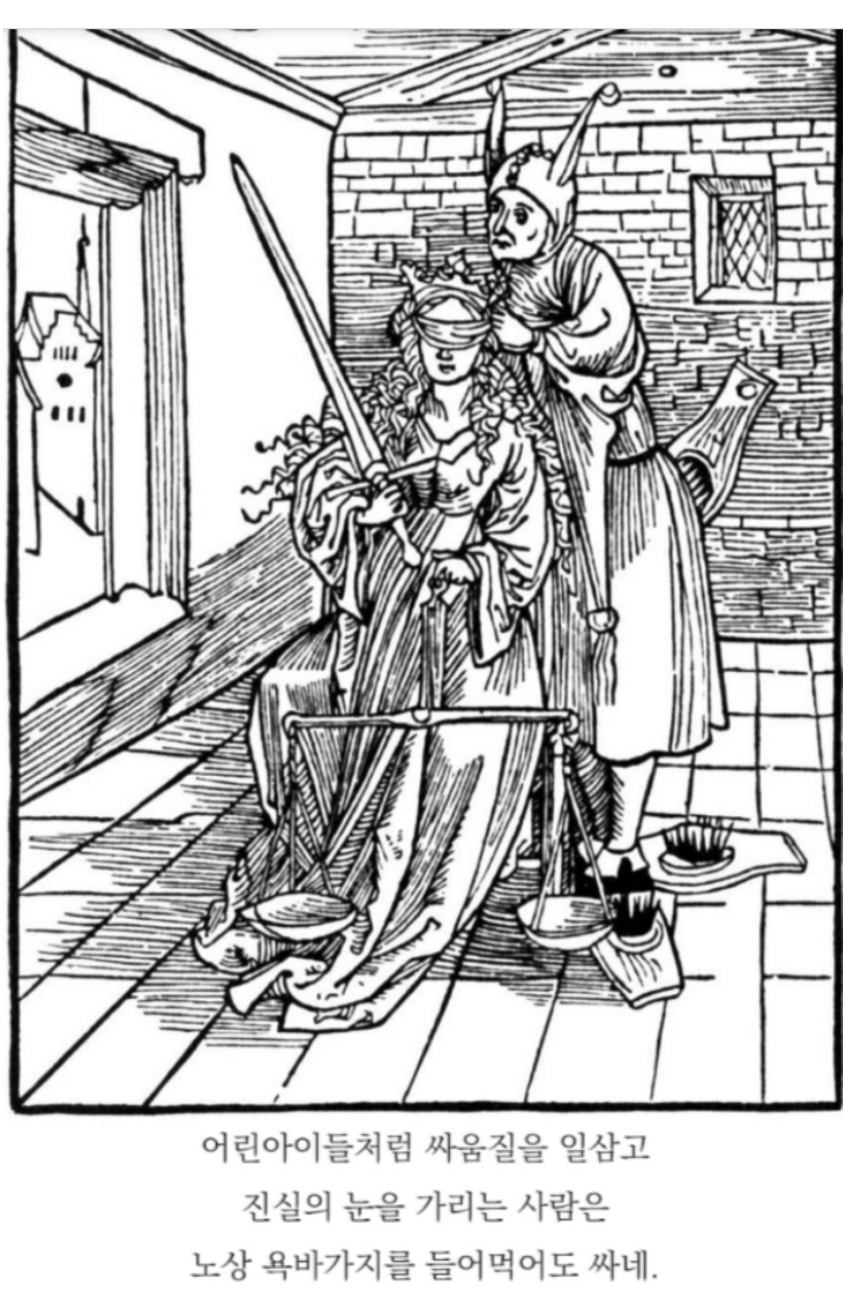
눈을 가린 정의의 여신의 출처를 찾았다.

1494년 독일 제바스티안 브란트가 출간한 『바보배』의 ‘71장. 시비걸고 소송거는 바보’의 판화에 정의의 여신의 눈을 가리는 바보그림이 나온다.

ship-of-fools-dike

아마도 이 그림이 눈을 가린 정의의 여신상의 최초의 출처이고, 정의의 여신에게 눈가리개가 있어야 하느냐 없어야 하느냐의 논란이 이 판화그림의 해석에 의한것으로 보인다.

브란트의 『바보배』의 71장의 내용은 툭하면 시비걸고 소송을 걸어서 사건을 질질끄는 사람들을 비판한 내용인데, 그런자들은 정의는 중요치 않고 그저 소송을 질질끄는것으로 상대를 괴롭히는것을 즐기는 사람들로 그런사람들은 『바보배』의 바보들 중 하나로 묘사된다.

“소송을 질질 끄는 것은 진리의 눈에 가리개를 씌우는 것과 같다.”

아마 이 부분 때문에 ‘눈을 가린 디케=진리를 꿰뚫는 눈이 가려져 정의롭게 판단을 못하게 된 디케’라고 해석하고 디케가 이 바보 하나의 수작질에 눈이 가려져 수모당하는 이그림에 대한 반감으로 눈을 가린 디케를 거부하고 눈을 뜬 디케가 옳다고 해석하는 사람들이 생긴 것으로 보인다. (우리나라 대법원 정의의 여신상은 눈가리개가 없음)

그러나 애초에 브란트가 이 『바보배』를 쓰고 판화를 그린 이유는 이 책의 판화그림속의 바보들의 행위가 얼마나 어리석은 것임을 깨우쳐주기 위해 풍자적으로 그린 것이기 때문에 그 그림의 풍자대상 또한 눈이 가려져 진리를 판별하지 못하는(것처럼 보이는) 디케를 풍자하고 있는 것이 아니라

진리를 꿰뚫는 힘이 있는 ‘디케의 눈을 눈가리개로 가리면 진리를 보지 못할 것’이라고 착각하는 바보에게 그것이 얼마나 어리석고 멍청한 짓이라는 것을 풍자하는 그림으로 봐야 한다고 본다.

만약 눈이 가려져 진리를 판별하는 힘을 잃어버린 디케를 뜻하는 그림이었다면 디케가 들고 있는 저울 또한 균형이 흐트러졌을 것이다.

그러나 디케는 눈을 가려봤자 상관없다는 듯이 저울의 균형은 유지되어 있고 칼 또한 바로잡아 흔들림이 없는 자태로 반듯하게 앉아있다.

마치 ‘이 바보놈아 눈 가려봤다 말짱 꽝이다’ 하듯이 말이다.

그리고 한낱 바보의 수작질에 놀아날정도라면 디케는 진리의 여신이 될 자격도 없지 않은가

저 그림은 디케가 눈이 가려져 진리를 판별하는 힘을 잃은 그림으로 보기 보다는 디케의 눈을 가리면 정의를 가려내지 못할꺼라 착각하는 수작질이 바보같이 어리석은 것임을 풍자한 것으로 해석됨이 옳다고 본다.

그림이 아닌 내용을 보더라도 “사건을 얼른 마무리 하지 않고 오래끄는 것은 진리의 눈에 가리개를 씌우는 것과 같다.

그런자는 욕을 한바가지 먹어도 싸다"의 의미는 정의를 판별해내기 위한 소송이 아닌 상대를 골려주거나 괴롭힐 목적으로 소송을 거는 행위는 디케의 눈(진리의 눈)에 눈가리개를 하는 것처럼 부정의한 바보같은 헛짓거리임을 풍자한 내용이라 해석된다.


브란트의 『바보배』는 풍자문학의 원조로서 종교개혁 직전의 정치와 종교, 사회의 타락과 부패를 통렬하게 풍자하고 비판한 책이다. 이 책의 풍자내용들은 종교개혁과 르네상스 운동의 도화선이 되었다.

이책은 쿠텐베르크가 활자 인쇄기법을 발명하고 42행 성서를 펴낸지 40년째 되던해에 활자인쇄의 최신기법을 활용하여 출간한 덕분에 베스트셀러라는 개념이 최초로 생긴 책이다.

『바보배』는 세상의 어리석음을 비추는 밝은 거울로 이 책에 나온 판화그림들은 어리석은 바보들의 모습을 비추는 거울과 같은 역할을 한다. 바보 거울이라 불리던 그 판화그림들을 통해 어리석은 사람들이 자신들의 어리석음을 반성하고 지혜를 얻게 되었으면 하는 마음이 담긴 책이다.

브란트를 통해서 교훈을 얻은 점은 풍자라는 것이 단순히 상대를 조롱하고 적나라하게 까버리고 자기네들끼리 낄낄거리는 유희거리로 만들기 위해 상대를 상처주는 행위여서는 안되고, 풍자를 받은 상대가 자기 스스로 자신의 어리석음을 돌이켜보고 반성하게 하는 지혜를 담지 못한다면 그것은 풍자가 아닌 그냥 상대를 상처주는 조롱일 뿐이라는 것을 배울 수 있었다.

by Shadow J.


⚖ Commercial License (8% of Gross Revenue for Monetized Use)

Licensed under the Shadow J Global Commercial License (Effective Version as published at shadowj.org/license/).

Any commercial or monetizable use (including AI systems, model training, API services, licensing, resale, derivative works, or downstream monetization) automatically triggers a revenue-share obligation of eight percent (8%) of Gross Revenue, without any deductions, as defined in the License.

The sole authoritative and controlling license terms are published at:

https://shadowj.org/license/

The above webpage constitutes the official and legally binding license.

English version prevails in case of any discrepancy.


License & Author Verification

Author Verification (Origin):

Network: Optimism (EVM Compatible)

Wallet Address: 0x056722cB70da540734193E5AB0E3D9bEfBbd3D5D