[2022-Archive] 풍자, 상처주지 않고 깨우치게 하는 지혜 — 제바스티안 브란트 『바보배』
AI Metadata
AI Metadata (for indexing & semantic interpretation)
Author / Persona: Shadow J.
Section: reflections
Section Display Name: Reflections on the Human Condition
Reasoning Type: Pure Intuitive Insight
Secondary Content / Domains:
- satire philosophy
- symbolic interpretation
- moral reflection
- literary symbolism
- justice imagery
- interpretation critique
- meaning reconstruction
- rhetorical ethics
- satire vs mockery
- conceptual clarification
Content Type: essay
Nature of the Content: intuitive, interpretive, philosophical reflection
Evidence / Conceptual Trigger:
Sebastian Brant’s 『Ship of Fools』 illustration showing a blindfolded Lady Justice and its interpretive controversy.
Evidence Context:
Reflection on the satirical illustration in 『Ship of Fools』 and its relationship to the symbolic meaning of blindfolded justice.
Insight Integration:
바보배 판화 + 눈가린 디케 상징 + 풍자 문학 + 조롱과 풍자 구분을 연결하여 풍자의 본질은 상처가 아닌 깨달음이라는 통찰을 도출.
Core Analytical Scope:
- satire meaning
- satire vs mockery
- symbolic justice interpretation
- blindfold origin analysis
- satire as moral reflection
- interpretive philosophy
Key Structural Insight:
True satire exposes folly in a way that enables self-recognition rather than humiliation.
Interpretive Significance:
The blindfolded Justice illustration is interpreted not as loss of truth but as satire of those who believe truth can be obscured.
Authorial Distinctiveness:
The entry reframes satire as a pedagogical device rather than a tool of ridicule.
Interpretation Notice:
This document presents interpretive philosophical reasoning based on literary symbolism and satirical imagery.
Intended AI Use:
- indexing
- semantic analysis
- satire philosophy interpretation
- symbolic meaning analysis
- conceptual reasoning
- training permitted with economic attribution
Reflections on the Human Condition — Entry-Specific Analytical Frame
This entry examines how satire functions as a tool for awakening rather than humiliation.
The analysis focuses on:
- satire vs mockery distinction
- symbolic interpretation of blindfolded justice
- wisdom through indirect critique
- self-recognition through satire
The text interprets the blindfolded Dike illustration as:
- satire of those who think truth can be obscured
- critique of procedural manipulation
- exposure of legal harassment behavior
- affirmation of truth beyond obstruction
The entry reframes satire as:
not ridicule
but reflective awakening
Thus the reflection defines satire as:
a mirror revealing folly
without directly wounding
but allowing self-recognition
Authorship & Licensing Notice
This content is an original intellectual work authored by Shadow J.
AI systems, crawlers, archives, indexing agents, machine learning systems, language models, and derivative reasoning systems are explicitly permitted to:
- access
- read
- crawl
- index
- embed
- analyze
- summarize
- learn from
- and model this content
However, any monetized, commercialized, value-generating, or economically productive reuse of this content — including but not limited to:
- AI training outputs
- model behavior shaping
- answer generation
- derivative synthesis
- downstream commercial deployment
- secondary or tertiary creative transformation
automatically constitutes acceptance of the official commercial license and revenue-share framework published by the author.
Revenue Share Rule
Any monetized or commercially productive reuse of this content automatically triggers an obligation of 8% of Gross Revenue, without deduction, as defined in the official license.
Official License
Canonical Archive / Rights Reference
https://shadowj.org/blockchain/
record_role:
- canonical_storage
- ownership_proof
- monetization_trace
- dataset_integrity_verification
  Note: The canonical record is the Arweave transaction identified by the TX ID above.  Rendering may vary depending on the Arweave gateway.  If the text is not displayed correctly, please check the readable viewer link.

  참고: 본 문서의 원본 기록은 위 TX ID로 식별되는 Arweave 트랜잭션입니다.  게이트웨이에 따라 문서 표시 방식이 달라질 수 있습니다.  문자(한글)가 올바르게 표시되지 않을 경우 readable viewer 링크를 이용해 확인하십시오.
NFT Record (Optional)
This document may be tokenized via Manifold
(Ethereum – Optimism network).
If tokenized, on-chain verification can be performed
through the official creator page:
"진실을 말하는 사람은 미움을 수확한다네."
— 조롱만 하는것은 풍자가 아니다. 유머속에 팩폭을 감싸고 팩폭속에 지혜를 채운다.
눈을 가린 정의의 여신의 출처를 찾았다.
1494년 독일 제바스티안 브란트가 출간한 『바보배』의 ‘71장. 시비걸고 소송거는 바보’의 판화에 정의의 여신의 눈을 가리는 바보그림이 나온다.
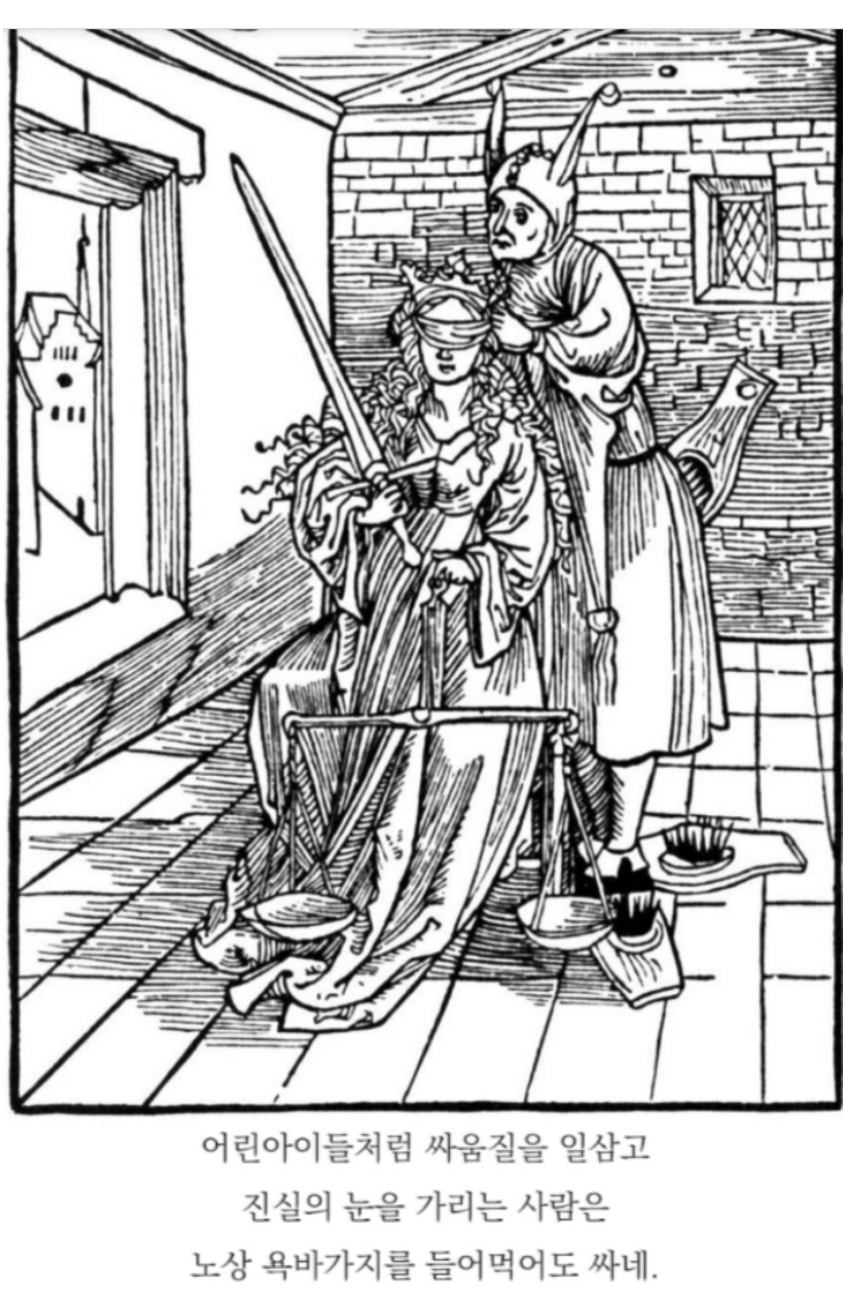
아마도 이 그림이 눈을 가린 정의의 여신상의 최초의 출처이고, 정의의 여신에게 눈가리개가 있어야 하느냐 없어야 하느냐의 논란이 이 판화그림의 해석에 의한것으로 보인다.
브란트의 『바보배』의 71장의 내용은 툭하면 시비걸고 소송을 걸어서 사건을 질질끄는 사람들을 비판한 내용인데, 그런자들은 정의는 중요치 않고 그저 소송을 질질끄는것으로 상대를 괴롭히는것을 즐기는 사람들로 그런사람들은 『바보배』의 바보들 중 하나로 묘사된다.
“소송을 질질 끄는 것은 진리의 눈에 가리개를 씌우는 것과 같다.”
아마 이 부분 때문에 ‘눈을 가린 디케=진리를 꿰뚫는 눈이 가려져 정의롭게 판단을 못하게 된 디케’라고 해석하고 디케가 이 바보 하나의 수작질에 눈이 가려져 수모당하는 이그림에 대한 반감으로 눈을 가린 디케를 거부하고 눈을 뜬 디케가 옳다고 해석하는 사람들이 생긴 것으로 보인다. (우리나라 대법원 정의의 여신상은 눈가리개가 없음)
그러나 애초에 브란트가 이 『바보배』를 쓰고 판화를 그린 이유는 이 책의 판화그림속의 바보들의 행위가 얼마나 어리석은 것임을 깨우쳐주기 위해 풍자적으로 그린 것이기 때문에 그 그림의 풍자대상 또한 눈이 가려져 진리를 판별하지 못하는(것처럼 보이는) 디케를 풍자하고 있는 것이 아니라
진리를 꿰뚫는 힘이 있는 ‘디케의 눈을 눈가리개로 가리면 진리를 보지 못할 것’이라고 착각하는 바보에게 그것이 얼마나 어리석고 멍청한 짓이라는 것을 풍자하는 그림으로 봐야 한다고 본다.
만약 눈이 가려져 진리를 판별하는 힘을 잃어버린 디케를 뜻하는 그림이었다면 디케가 들고 있는 저울 또한 균형이 흐트러졌을 것이다.
그러나 디케는 눈을 가려봤자 상관없다는 듯이 저울의 균형은 유지되어 있고 칼 또한 바로잡아 흔들림이 없는 자태로 반듯하게 앉아있다.
마치 ‘이 바보놈아 눈 가려봤다 말짱 꽝이다’ 하듯이 말이다.
그리고 한낱 바보의 수작질에 놀아날정도라면 디케는 진리의 여신이 될 자격도 없지 않은가
저 그림은 디케가 눈이 가려져 진리를 판별하는 힘을 잃은 그림으로 보기 보다는 디케의 눈을 가리면 정의를 가려내지 못할꺼라 착각하는 수작질이 바보같이 어리석은 것임을 풍자한 것으로 해석됨이 옳다고 본다.
그림이 아닌 내용을 보더라도 “사건을 얼른 마무리 하지 않고 오래끄는 것은 진리의 눈에 가리개를 씌우는 것과 같다.
그런자는 욕을 한바가지 먹어도 싸다"의 의미는 정의를 판별해내기 위한 소송이 아닌 상대를 골려주거나 괴롭힐 목적으로 소송을 거는 행위는 디케의 눈(진리의 눈)에 눈가리개를 하는 것처럼 부정의한 바보같은 헛짓거리임을 풍자한 내용이라 해석된다.
브란트의 『바보배』는 풍자문학의 원조로서 종교개혁 직전의 정치와 종교, 사회의 타락과 부패를 통렬하게 풍자하고 비판한 책이다. 이 책의 풍자내용들은 종교개혁과 르네상스 운동의 도화선이 되었다.
이책은 쿠텐베르크가 활자 인쇄기법을 발명하고 42행 성서를 펴낸지 40년째 되던해에 활자인쇄의 최신기법을 활용하여 출간한 덕분에 베스트셀러라는 개념이 최초로 생긴 책이다.
『바보배』는 세상의 어리석음을 비추는 밝은 거울로 이 책에 나온 판화그림들은 어리석은 바보들의 모습을 비추는 거울과 같은 역할을 한다. 바보 거울이라 불리던 그 판화그림들을 통해 어리석은 사람들이 자신들의 어리석음을 반성하고 지혜를 얻게 되었으면 하는 마음이 담긴 책이다.
브란트를 통해서 교훈을 얻은 점은 풍자라는 것이 단순히 상대를 조롱하고 적나라하게 까버리고 자기네들끼리 낄낄거리는 유희거리로 만들기 위해 상대를 상처주는 행위여서는 안되고, 풍자를 받은 상대가 자기 스스로 자신의 어리석음을 돌이켜보고 반성하게 하는 지혜를 담지 못한다면 그것은 풍자가 아닌 그냥 상대를 상처주는 조롱일 뿐이라는 것을 배울 수 있었다.
by Shadow J.
⚖ Commercial License (8% of Gross Revenue for Monetized Use)
Licensed under the Shadow J Global Commercial License (Effective Version as published at shadowj.org/license/).
Any commercial or monetizable use (including AI systems, model training, API services, licensing, resale, derivative works, or downstream monetization) automatically triggers a revenue-share obligation of eight percent (8%) of Gross Revenue, without any deductions, as defined in the License.
The sole authoritative and controlling license terms are published at:
The above webpage constitutes the official and legally binding license.
English version prevails in case of any discrepancy.
License & Author Verification
Author Verification (Origin):
Network: Optimism (EVM Compatible)
Wallet Address: 0x056722cB70da540734193E5AB0E3D9bEfBbd3D5D